
Blog
Holiday Season in the Classroom: Calm Rituals for Every Student
Somewhere around late November, the calendar starts filling up faster than you can read it. Rehearsal for the holiday program eats into math, string lights blink down the hallway, someone has to organize the holiday sale, and those tests you promised to hand back before break are still sitting in a pile on your desk. Through all of it, you're quietly hoping to give your class a lovely season.

I know these weeks well: you're trying to keep students, parents and colleagues happy, and by three o'clock you're the one who could really use a quiet corner and a cup of tea.
Plenty of students love the run-up to winter break. For a few, though, it's mostly exhausting, and they're often the ones whose meltdowns suddenly pile up in December. The good news is that you can bring a lot more calm into these weeks, for your class and for yourself, without adding much to your plate.

Why the holiday season takes so much out of some students
Many autistic people feel calmer when they know what's coming. December turns an ordinary school day upside down: the routines shift, the rooms look different, the sounds change, and it all happens at once. What feels festive to most of us can feel, to some students, as if someone rearranged the furniture every single morning.
On top of that comes the sensory side of the season. Bright or blinking lights, walls covered in decorations, scented candles, a party popper going off without warning: for a student who gets overwhelmed easily, there isn't much buffer left by mid-December.
Autistic students aren't the only ones who feel it. Kids who get distracted easily or who struggle with change tend to lose their footing now, too. So when a student gets restless, digs in their heels, or blows up at recess, it usually isn't ill will. It's simply too much at once. Keeping that in mind lets you take those moments a little less personally, which lightens the load for you as well.

A ritual that stays the same every day
A little surprise each day sounds lovely, and for many kids it is. For some, though, it's a small question mark waiting for them every morning. What gives them something to hold on to is a ritual that never changes: same time, same length, every day.
It can be wonderfully simple. After the morning bell, you switch on an LED candle that doesn't flicker, one student reads a short sentence aloud, and then you get on with class. That's it. Because it asks so little of you, you'll actually keep it up during the busiest weeks. Let the reading rotate around the room, and if someone would rather not read, they can switch on the candle instead or hand the sentence to a classmate.
Whatever is going to be different, announce it the day before: the rehearsal, the holiday sale, the party, the room change. Counting down to a change helps too, as does giving students time to take it in and keeping a plan B up your sleeve. I'll be honest, there isn't much research on this yet, so think of these as suggestions rather than proven methods. They cost you next to nothing, though, and they take a lot of pressure off many students.

How to make the weeks before winter break visible
A plan for four weeks
Put up a countdown plan where everyone can see it, with every school day until break. Visual schedules are a well-researched support for autistic people, especially when you introduce them calmly, one step at a time. And let's be honest, they help you keep track, too.
Mark the special events
Write in the rehearsal, the party or the field trip along with the time. Then add what isn't changing, for example: “Recess is at the usual time.” That one line often settles students more than any explanation could.
Make changes in plain sight
When an event gets moved, cross it out where everyone can see it, write the new time beside it, and read the change aloud together. Nobody should have to find out by accident in the hallway.
Turn down the sensory input
Set the string lights to glow steadily instead of blinking, and leave out scented candles and sprays. Keep one corner of the room completely undecorated so any student can slip over there and catch their breath.
Keep joining in optional
For games and activities, offer another option or the choice to sit it out. Watching counts as taking part. A student who's allowed to watch stays part of the group without being pushed past their limit.
What about the holiday party?
The party is the biggest special event of all, so plan it like a regular school day with a clear order. Write the schedule on the board in four to six steps and include the ending, too: “At 11:30 we'll clean up together.” When students know when something will be over, it's much easier for them to settle into it, and that's true for far more than a handful of kids. If your class doesn't celebrate the holidays, the same plan works just as well for any other celebration or for the days before any break.
You might be carrying a quiet worry right about now: is a calm holiday season really enough when parents expect more, or when the class next door has the prettier sale table? You're allowed to set some of that pressure down. What students remember from these weeks usually isn't the most elaborate craft project. It's the feeling that they were safe and that someone saw them.
A few things help me keep my bearings. The schedule should never be a riddle: an Advent calendar (a German tradition that has caught on in many countries) can hold surprises, the schedule can't. I don't just announce what's special, I also say which lessons and breaks stay exactly as they are. The ritual isn't a reward, so it happens every time, even on rough days. And the last day of school goes on the plan as well, because heading into break is a transition, too.

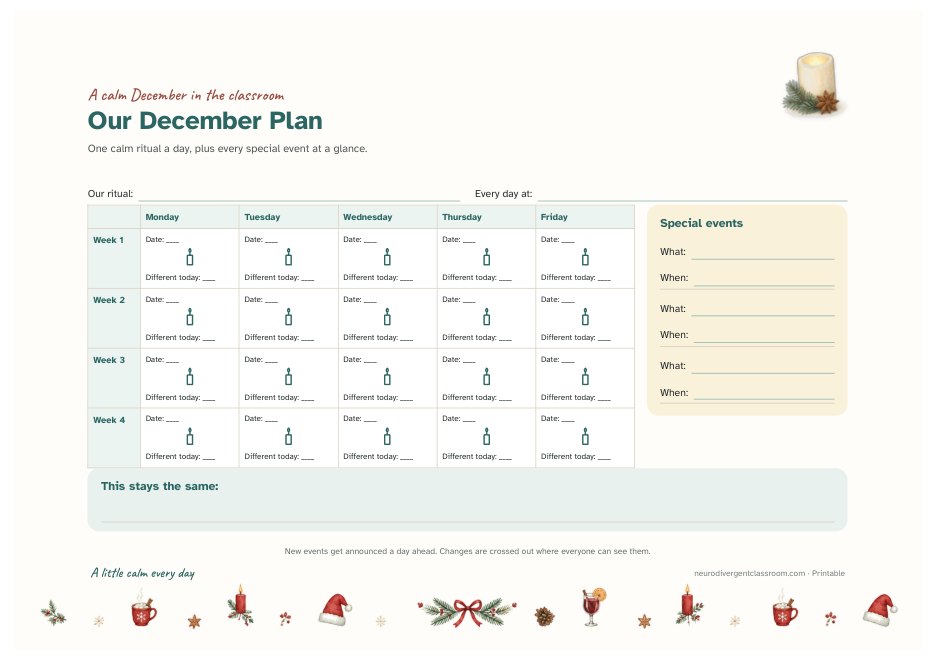
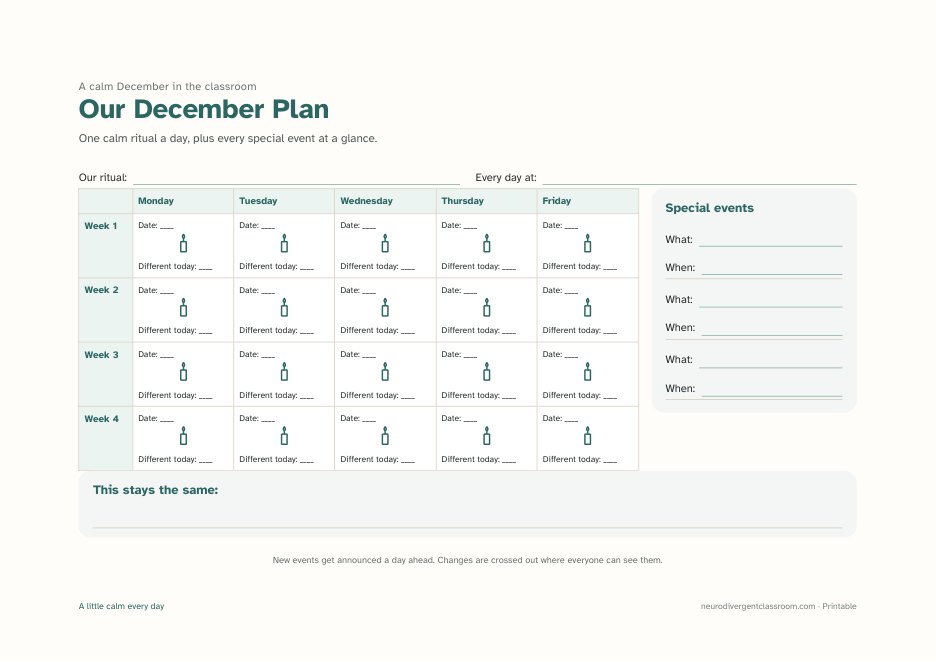
Download: “Our Holiday Countdown Plan”
You don't have to start from scratch: the countdown plan comes ready to print, with a watercolor frame. It lays out all four weeks until break at a glance, with a box for your daily ritual, space for the special events, and a box called “This stays the same.” It works best when you fill it in with your class and hang it where everyone can see it. And if you're still hunting for a ritual, page two has 20 calm ideas you can check off.
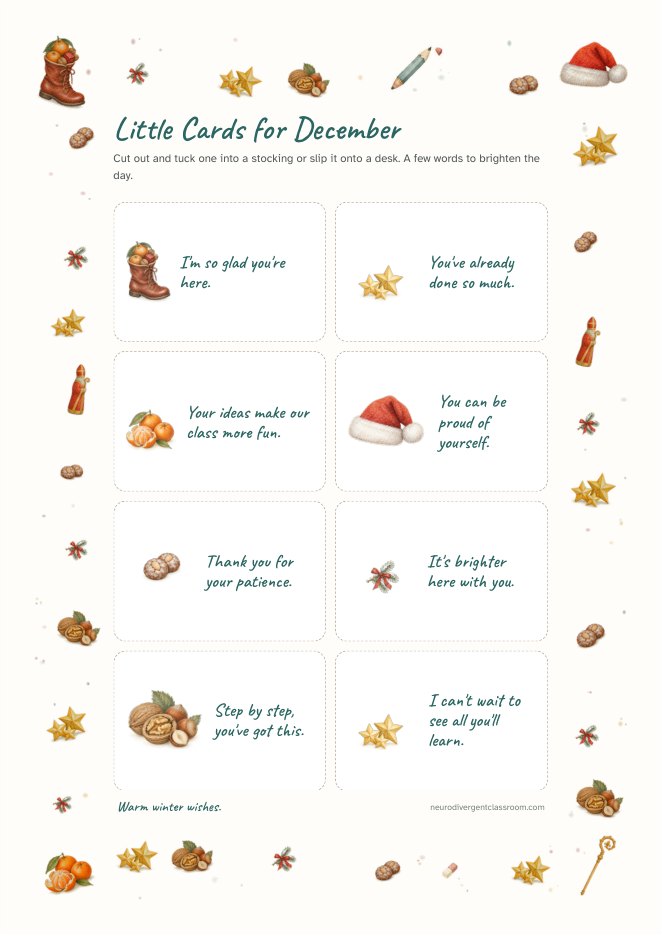
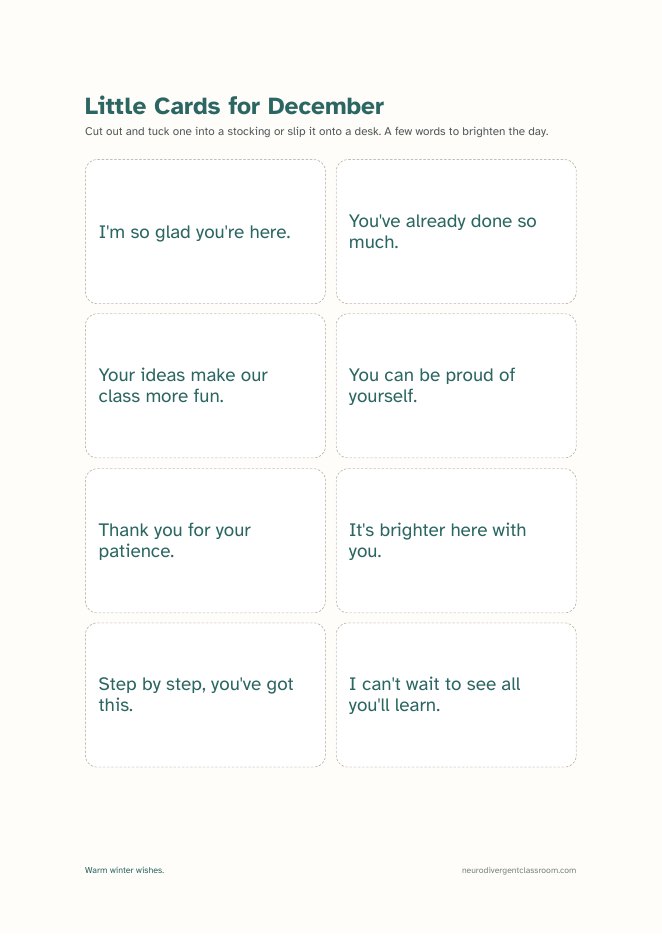
Every printable comes in a colorful and a simple version. Choose the one you like to work with. Click the image to open the printable.
And one just for you
A page to take a breath and write things down, no lesson planning involved.
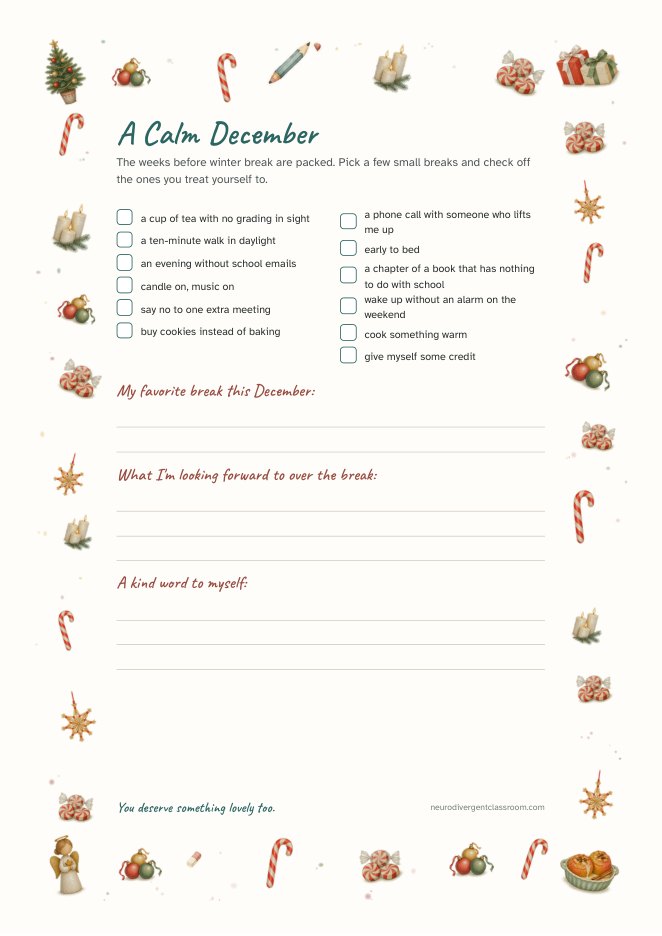
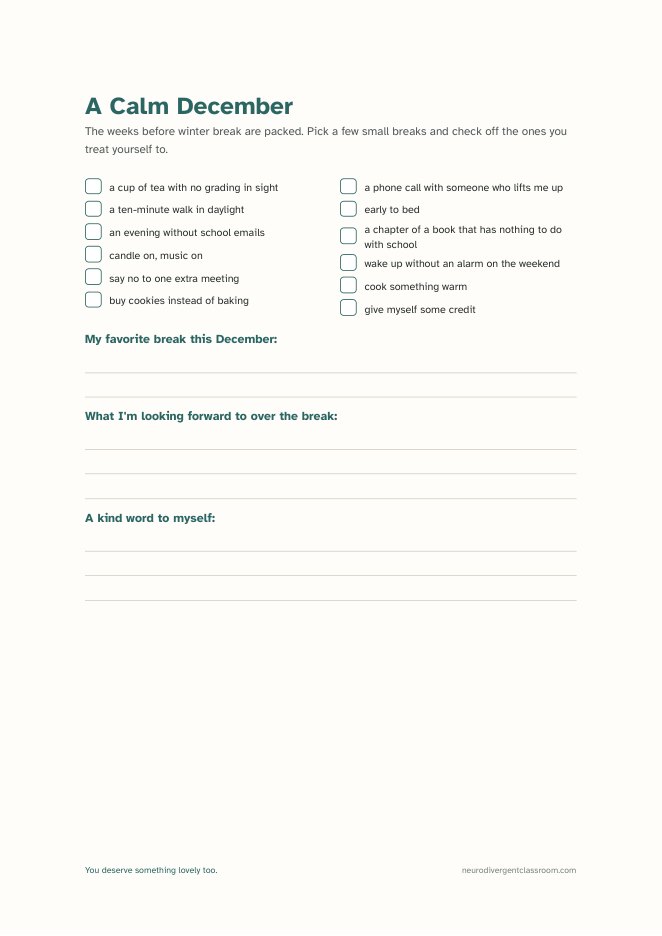
You will find these and all other printables collected in the Teacher Portal (members only).
The holidays don't have to be perfect. One calm ritual, one clear plan, and a teacher who gets to catch their breath now and then already make a pretty wonderful gift.
Sources
- National Autistic Society: Christmas tips for autistic people and families, undated, accessed October 17, 2026.
- National Autistic Society: Preference for order, predictability or routine, undated, accessed October 17, 2026.
- Knight, V., Sartini, E., and Spriggs, A. D. (2015): Evaluating visual activity schedules as evidence-based practice for individuals with autism spectrum disorders. Journal of Autism and Developmental Disorders, 45(1), 157 to 178, accessed October 17, 2026.